


ALM Pamela's Pro Workout Review: Features, Expanders & Use Cases
If your Eurorack system needs a timing brain that goes far beyond basic clock duties, Pamela's PRO Workout by ALM Busy Circuits deserves serious attention. This 8-channel module packs clocking, modulation, Euclidean rhythms, random CV generation and pattern tools into a compact 8HP footprint. In this post, we'll break down every major feature, explore how the PPEXP1 and AXON-2 expanders transform the workflow, and walk through real-world use cases so you can decide whether this module belongs at the center of your rack.
Key Takeaways
Pamela's PRO Workout by ALM Busy Circuits is an 8-channel clock, modulation and sequencing powerhouse that can become the timing brain of an entire Eurorack system, replacing multiple dedicated modules in the process.
Core upgrades over Pam's New Workout include a higher-resolution color screen, 12-bit output resolution, deeper modulation options, an improved waveform set, Euclidean and random tools, and more flexible clocking with divisions down to /16384 and multipliers up to ×192.
The PPEXP1 expander adds essential DIN sync, MIDI clock output and extra fixed gates, making Pamela's PRO Workout a master clock for DAWs, drum machines and vintage gear without needing separate converter modules.
The AXON-2 expander turns the module into a performance hub with four additional CV inputs, four offset knobs and two assignable buttons, allowing hands-on control over patterns and modulation in real time.
Combining Pamela's PRO Workout with both PPEXP1 and AXON-2 dramatically improves workflow, reducing patch complexity while centralizing timing, modulation and performance controls in a single ecosystem.

Overview: What Is ALM Busy Circuits Pamela's PRO Workout?
Pamela's PRO Workout (ALM-034) is an 8-channel programmable clock, modulation and sequencing module from ALM Busy Circuits. Released as the successor to the widely popular Pam's New Workout, the pro version builds on everything that made the original a staple in Eurorack racks worldwide while adding substantial improvements in resolution, waveform variety, timing flexibility and external interfacing.
Despite the fitness-themed name - a playful nod to the way workouts can be mixed and matched depending on fitness levels and goals - this is a Eurorack module, not a gym routine. Think of it as a pro workout for your modular patch rather than your body. Much like how Pamela Reif's workout methodology centers around high-energy home fitness routines and Pamela Reif's workouts improve strength and muscle tone through bodyweight exercises, this module strengthens and tones your entire patch from a single central hub.
The module fits neatly into the ALM Busy Circuits ecosystem and is designed as a compact timing and modulation hub in just 8HP. It features 8 independent outputs, a full-color OLED screen, a single encoder plus button interface, internal and external clocking, and extensive pattern and modulation tools. This article will focus on real-world workflow, the two key expanders (PPEXP1 and AXON-2), and how to integrate Pamela as the central clock in a modern Eurorack setup.
ALM Busy Circuits Pamela's PRO Workout Core Features & Technical Specifications
The feature set of Pamela's PRO Workout is dense. Here is a breakdown of what you get:
Physical & Power:
8HP width, skiff-friendly depth
Full-color high-resolution OLED display
Single program encoder + Start/Stop button
8 buffered outputs (0–5V), clock/reset inputs, expander headers
12-bit output resolution (4,096 discrete steps), up from 10-bit on PNW
Per-Channel Functions:
Function | Description |
Clock/Trigger/Gate | Standard pulse outputs with adjustable width |
LFO Shapes | Sine, triangle, trapezoid, hump, exponential, logarithmic |
Random CV | Classic random, smooth random with slew control |
Euclidean Rhythms | Steps, fills, rotation, padding |
Ratchets | ×2 and ×4 ratchet shapes |
Envelopes | Exponential and logarithmic envelope-like shapes |
Cross Operations | Mix, mask, multiply, S&H, logic (AND, OR, XOR, NOT, MIN, MAX) |
Timing Range:
BPM range: 10–330
Divisions down to /16,384; multiplications up to ×192
Non-integer values for dotted and triplet divisions
Flex timing modes: swing, human drift, ramp up/down, hump, delay
Memory & Presets:
64 memory banks for saving and recalling output configurations
USB-C backup as a disk for bank management
Settings persist through power cycles
Pamela Pro Workout features 8 independent outputs, each fully configurable with the parameters above. The menu structure is organized into per-channel pages with extended parameter screens accessible via long-press, plus global settings for BPM, sync and display preferences.
User Interface & Workflow Experience
It features a user-friendly interface with a single encoder - the same interaction philosophy inherited from earlier ALM designs. You twist to navigate, click to select, long-press to access extended parameters. The pro version's upgraded color OLED screen makes a meaningful difference: Euclidean patterns display as visual grids, a scope view lets you inspect output waveforms, and theme options improve readability under stage lighting.
Is there menu diving? Yes. Eight outputs with deep parameter sets cannot avoid it entirely. But ALM has taken care to minimize friction. Contextual labels on screen tell you exactly which parameter you are editing. Muting a channel takes a single key combination (hold Start/Stop, click encoder). Copying settings between channels is straightforward through the bank system.
Much like how routines feature zero verbal explanation synced to music for pacing, the interface communicates visually rather than with text-heavy menus. Quick tasks feel fast once you learn the muscle memory:
Dial in master BPM: twist encoder on home screen
Mute/unmute a channel: hold Start/Stop + click encoder
Change division: navigate to channel, twist to new value
Rotate Euclidean pattern: enter extended params, adjust rotation
Edit wave shape: long-press on channel, scroll to shape parameter
For aesthetics, note that replacement panels like the Golden Lotus and black panel options exist for people who want a themed case. Handle these swaps with care - the screen and LED components are fragile.
Clocking, Sync & Timing Capabilities
At its core, it includes a built-in clock generator running from 10 to 330 BPM with tap tempo support. The module supports various time signatures and divisions, and this is where its functionality truly shines. Every output can independently divide or multiply the master clock, including fractional values for dotted notes and triplets.
Much like how many sessions include fast-paced intervals that improve cardiovascular fitness, Pamela can drive rapid-fire triggers and complex polyrhythmic patterns that keep a patch alive and moving. Per-channel timing parameters include:
Division/Multiplication: from /16,384 to ×192
Phase offset: shift a channel's timing relative to the master clock
Pulse width: control gate length precisely
Delay: offset channel start point
Flex timing: swing, human drift, ramp patterns
Example patch for a drum rack:
Output 1 → Kick at ×1 (quarter notes)
Output 2 → Hi-hats at /3 (triplet feel)
Output 3 → Snare with Euclidean 5/8 pattern
Output 4 → Accent triggers at /16 with 40% probability
Jitter performance is minimal, making Pamela's PRO Workout suitable as a master clock in both studio and live contexts. External clock and reset inputs allow locking to other modules, drum machines or a DAW signal, so it works equally well as a follower when needed.
Modulation, LFOs & Random Functions
Each of the 8 outputs can generate tempo-synced LFOs, stepped CV, random voltages and envelope-like shapes - not just triggers and gates. Pamela Pro Workout allows for customizable modulation patterns on every channel, with parameters including amplitude, offset, wave shape, skew, phase, randomness and probability all available per output.
Her routines provide a variety of workouts that prevent boredom and maintain engagement - the same principle applies here. Users can rotate between strength, cardio, and stretching-focused sessions in a fitness context; similarly, you can rotate Pamela's outputs between rhythmic duties, smooth modulation and random generative CV to keep patches evolving.
Musical use cases:
Triangle LFO on Output 5 modulating filter cutoff, synced to 2 bars
Smooth random on Output 6 driving reverb send levels
Exponential envelope on Output 7 controlling wavefold depth
Sine LFO on Output 8 gently modulating oscillator pitch for vibrato
Because each LFO locks to the master BPM, all modulation stays musically coherent. This is a nice way to replace multiple dedicated LFO and random modules, freeing up space in smaller cases. The cross operations (mix, multiply, sample & hold, logic) applied between outputs add another layer - one channel's random output can modulate another channel's probability, creating genuinely generative behavior from a single module.
Euclidean, Probability & Pattern Tools
Euclidean pattern generation is one of Pamela's most creatively rewarding features. You set the number of steps, fills and rotation per channel, and the module distributes triggers as evenly as possible across the pattern length. Just as individual videos focus on specific muscle zones for targeted workouts, individual outputs can focus on specific rhythmic roles.
Weekly calendars cycle through targeted split days and dedicated rest days in a fitness program. Similarly, the program includes built-in recovery days to optimize muscle recovery - and Pamela mirrors this concept with Loop Nap/Wake, which cycles outputs through active and silent phases over multiple bars. This creates breathing room in a pattern without manual intervention.
Key pattern tools per channel:
Euclidean steps, fills, rotation and padding
Probability (0–100% chance per step)
Loop Nap/Wake for cyclic silence/activity
Pattern saving across 64 banks
Combining Euclidean patterns at different lengths across outputs yields polymeters that are still easy to manage. Output 1 running a 5/8 pattern while Output 2 runs 7/12 creates interlocking rhythms that evolve over long cycles - ideal for techno, IDM or generative ambient work.
Integration with the ALM Busy Circuits Pamela's PRO Workout Ecosystem
Pamela's PRO Workout fits naturally into a broader ALM Busy Circuits system. Modules like Squid Salmple, MFX and various ALM utilities all benefit from being clocked by Pamela. A typical signal flow might look like:
Pamela Output 1 → Squid Salmple clock (triggering sample playback)
Pamela Output 2 → MFX tap tempo (syncing rhythmic effects)
Pamela Output 3–6 → Drum voices and sequencer gates
Pamela Output 7–8 → Modulation duties (filter sweeps, parameter movement)
The companion app provides macro-calculated recipes and meal planning in Pamela Reif's fitness world; in the ALM world, the ecosystem provides a similarly integrated experience where modules are designed to work together seamlessly. The cosmetic options (Golden Lotus, black panels) let you visually unify an ALM-focused skiff, though panel swaps should be done carefully to avoid damage.
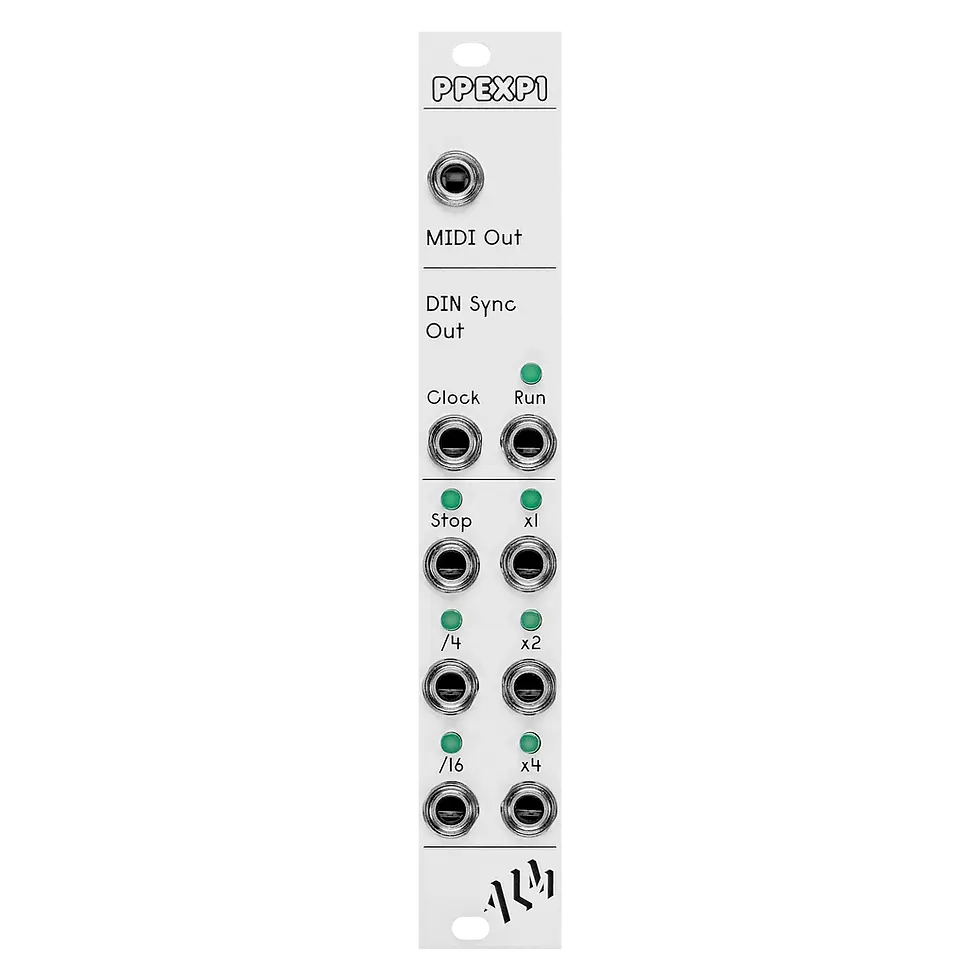
PPEXP1 Expander: DIN Sync, MIDI & Extra Gates
The PPEXP1 is the output expander that extends Pamela's reach beyond the Eurorack case. At just 4HP and approximately 40 mA draw at +12V, it connects via ribbon cable to Pamela's internal header and adds dedicated external sync outputs.
What PPEXP1 provides:
Output | Function |
MIDI Out | 3.5mm TRS, switchable Type A/B |
DIN Sync Clock | Roland-style sync for vintage gear |
DIN Sync Run | Start/stop signal for DIN sync devices |
×1, ×2, ×4 Gates | Fixed clock multiplier outputs |
/4, /16 Gates | Fixed clock divider outputs |
Stop Output | Dedicated stop trigger |
Concrete use cases:
Sync a TR-style drum machine via DIN sync while using Pamela's main 8 outputs for in-rack modulation
Send MIDI clock to a DAW or hardware sequencer without sacrificing any of Pamela's channels
Use the fixed gate outputs for basic timing duties, reserving the main outputs for complex patterns and LFOs
PPEXP1 effectively removes the need for separate MIDI-to-clock or DIN sync converter modules. It turns Pamela's PRO Workout into a universal master clock interface, and that link between your modular and external world becomes seamless.
AXON-2 Expander: Performance Control & CV Inputs
Where PPEXP1 focuses on external sync, AXON-2 focuses on hands-on control. This performance-oriented expander adds physical interface elements that transform Pamela from a set-and-forget clock into a playable instrument.
AXON-2 provides:
4 additional CV inputs with attenuation and offset
4 manual offset knobs (one per CV input)
2 assignable performance buttons
Live performance scenarios:
Map a knob to Euclidean rotation on your snare channel - twist to shift the pattern in real time
Assign a button to mute/unmute the hi-hat output for instant fills
Route an external envelope follower into AXON-2's CV input, mapped to probability on a melodic gate channel
Use a button to reset random seeds, creating repeatable generative sections
CV inputs on AXON-2 can be mapped to BPM, probability, pattern length, waveform selection or other per-channel parameters. This means other modules in your rack can dynamically control Pamela's behavior without any menu interaction.
The contrast with PPEXP1 is clear: PPEXP1 handles external sync I/O, AXON-2 handles hands-on control and modulation input. They serve completely different roles and complement each other perfectly.

Combining Pamela's PRO Workout with PPEXP1 & AXON-2
Running Pamela's PRO Workout with both expanders attached creates a three-module control center for your entire system. Here is a concrete walkthrough of a full hybrid setup:
Pamela PRO as master clock at 128 BPM
Outputs 1–4: drum triggers (kick, snare, hats, percussion) using Euclidean patterns
Outputs 5–6: tempo-synced triangle and sine LFOs modulating filter and wavefolder
Outputs 7–8: smooth random CV for generative pitch sequences (quantized to minor scale)
PPEXP1 handling external sync
MIDI out → hardware groovebox receiving clock
DIN sync → vintage TR-606 locked to master tempo
Fixed ×1 gate → DAW audio interface clock input
AXON-2 providing live control
Knob 1 → Euclidean rotation on snare channel
Knob 2 → probability on hi-hat channel
Button 1 → mute/unmute percussion output for fills
CV Input 1 ← expression pedal mapped to master BPM for tempo rides
This combination means fewer separate clock, reset, logic, LFO and MIDI utility modules are needed. Cable runs simplify. Improvisation becomes fluid because timing, external sync and performance controls are all centralized. In compact live cases where every HP matters, this is especially powerful - redundancy is removed and everything runs from one tightly integrated set of modules.
Real-World Use Cases Across Different Rigs
Small Starter Racks (3U / 84HP or less): Pamela Reif's program is designed for home-based training with online accessibility - and similarly, Pamela's PRO Workout is designed to do maximum work in minimal space. Many routines are bodyweight-focused and require minimal or no equipment; likewise, a small rack can rely on Pamela alone for all clock, LFO and pattern duties. Four channels on drums, four on modulation. No external sequencer needed.
Medium Performance Skiffs: Pam + PPEXP1 + AXON-2 at the center, clocking drum voices, sequencers and FX. Workouts often range from 8 to 45 minutes in duration - and a live set of similar length benefits from bank-based song recall, AXON-2 fills and mutes, and PPEXP1 syncing a groovebox or laptop.
Large Studio Systems: Pamela distributes clock to multiple racks and external hardware. PPEXP1 interfaces with MIDI-equipped synths and DAWs. AXON-2 receives automation CV from sequencers for parameter modulation across Pamela's outputs.
Genre-Specific Examples:
Techno/IDM: odd Euclidean patterns (7/12, 5/8), cross-ops for accent logic, Flex swing for groove
Generative Ambient: smooth random on multiple outputs, Loop Nap/Wake for evolving density, probability-based triggers
Live Hybrid: DAW sync via PPEXP1, AXON-2 buttons for fill punches, banks for song sections
Alternatives, Limitations & Who Pamela's PRO Workout Is For
Other multi-channel clock and modulation modules exist - hardware options from various manufacturers and software solutions like VCV Rack's clocking modules. But Pamela's PRO Workout stands apart in density of features per HP, tight timing performance, ALM Busy Circuits ecosystem integration, and the expander options that no competitor matches in quite the same way.
Honest limitations:
All CV outputs are positive-only (0–5V) - no bipolar signals without external shifting
Menu-based control with a single encoder means some tasks are slower without AXON-2
Only one output expander (PPEXP1 or PPEXP2) can be used at a time
At very slow modulation rates, 12-bit stepping artifacts can become audible
Ideal users:
Live performers needing centralized clocking with hands-on control
Studio producers integrating multiple hardware devices via MIDI and DIN sync
Minimalists who want maximum functionality from minimal HP
People building generative or Euclidean-heavy patches
If you prefer dedicated knob-per-function interfaces or need bipolar CV natively, this may not be the right fit. But for everyone else, it is hard to find a more capable module in 8HP.
FAQ
Can I use Pamela's PRO Workout as my only clock and modulation source in a small Eurorack case?
Yes, and many people do exactly this. In a 3U/84HP or smaller setup, the 8 flexible channels can simultaneously handle drum triggers, sequencer clocks and tempo-synced LFOs, often replacing several simpler modules. As your system grows, adding PPEXP1 and AXON-2 extends Pamela's usefulness rather than forcing a clock upgrade. It is a strong foundation to build around from day one.
Do I need both the PPEXP1 and AXON-2 expanders, or is one enough?
Neither expander is strictly required - Pamela's PRO Workout functions fully on its own. PPEXP1 is most useful if you sync to external hardware or DAWs frequently, while AXON-2 is best for hands-on performance control and extra CV input. Users focused on studio sync should start with PPEXP1. Live performers should start with AXON-2. Power users benefit from running both simultaneously, and the module supports this configuration.
Will replacing the front panel (e.g., Golden Lotus or black panel) void my warranty?
Third-party or user-installed replacement panels are typically not covered by ALM's warranty and can risk damage if installed incorrectly. Handle the module with care due to fragile screen and LED components, and check ALM's official policy or dealer guidance before attempting any panel swap. If you are unfamiliar with DIY hardware, either keep the stock panel or have an experienced technician perform the swap.
How does Pamela's PRO Workout differ from the original Pam's New Workout?
The pro version adds a higher-resolution color screen, 12-bit output resolution (up from 10-bit), expanded waveform and modulation options, improved menu navigation, deeper pattern tools including enhanced Euclidean displays, cross operations, Flex timing modes, custom quantizer scales, and compatibility with newer expanders. Firmware updates continue to add functionality. Users building a new system should generally prefer Pamela's PRO Workout over older versions due to its extended feature set and future-proof design.
Is Pamela's PRO Workout suitable for complex polyrhythms and odd time signatures?
It excels at this. Independent division, multiplication, offset and pattern length per channel mean you can run completely different time signatures simultaneously. Euclidean tools with rotation parameters allow quickly creating non-4/4 rhythms and polymeters. Running one channel at 5/8 while another runs 7/12 and a third provides a standard 4/4 kick creates layered complexity that is still manageable from a single module. This makes it a natural choice for IDM, experimental techno and generative rhythmic structures.
